Home Learn The Weakest Part of a Roof Is Its Edges
Basics 9 minute readThe Weakest Part of a Roof Is Its Edges
By Anthony Limpert, Founder, published October 31, 2026
Most people think the shingles are the weak part of a roof. Water, wind and embers go for the edges and joints instead. We show where each one gets in.
The weakest part of a roof is every place it stops or meets something else. For water, that means flashing at walls, chimneys, valleys and pipes. The Department of Energy Building America guide says a roof needs step and kick out flashing at every roof to wall joint and boot or collar flashing at every pipe, per the Building America Solution Center. For wind, it is the outer edge and the corners. FM Global says corner uplift can be more than two and a half times the uplift on the middle of a roof.
First Things
- Leaks usually start at the joints, like flashing, pipe boots and valleys, not the open field of shingles.
- The rubber seal on a plumbing vent boot can fail in as little as 10 to 15 years.
- Wind lifts the corners and the outer edge first, then peels the roof back from there.
- Under the roof, the nails that tie rafters to the walls are a weak link in a big storm.
- In fire season, vents, gutters and open tile ends let embers in before the roof itself burns.
- Most of these weak spots can be fixed without a new roof.
Water Gets In Where the Roof Stops
A roof field is simple. Each course of shingle or tile laps over the one below. Water runs down and off. That part rarely fails first.
Trouble starts where that pattern breaks. A wall rises out of the roof. A chimney pokes through. Two slopes meet in a valley. Each spot needs a metal or rubber part to carry water past the joint. That part is the flashing.
Heavy rain can pour thousands of gallons onto a roof in one storm, per the Building America Solution Center. A roof to wall joint funnels much of it toward the edge of that wall. If the side wall flashing is thin or missing, water runs into the wall.
The same guide sets the basics. Step flashing should run at least 4 inches up the wall. Each piece overlaps the one below. Metal flashing should be at least 0.019 inches thick, about 26 gauge.
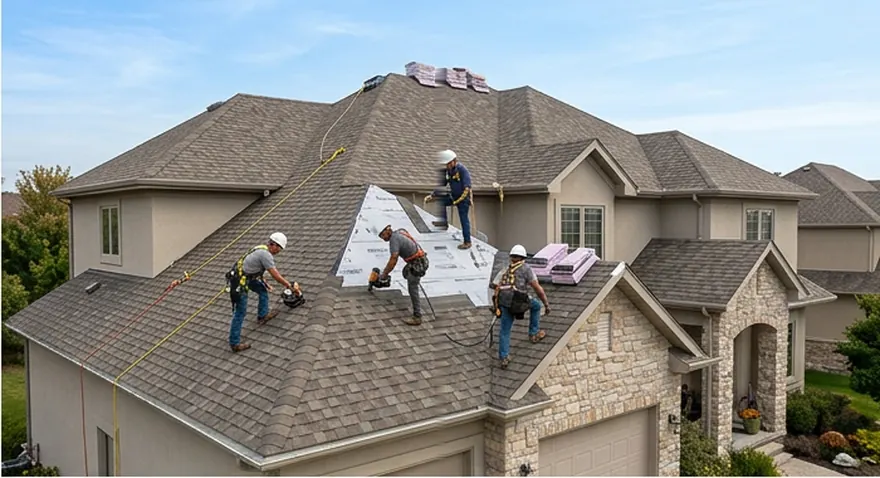
The worst part is that you may not see it. Fiber cement, vinyl and brick veneer can hide the damage for years, the guide warns. Look for streaks, mold or peeling paint on the wall below where a roof meets it. Our flashing guide walks through each type by name.
The Small Parts That Leak First
Some joints fail more often than others. These are the usual suspects. Check them in this order.
- Pipe boots. Each plumbing vent wears a rubber collar. The rubber can fail in as little as 10 to 15 years, per Tim Carter of Ask the Builder. A cracked boot often means a new boot, not a new roof.
- Kick out flashing. A missing kick out at the bottom of a roof to wall joint often leads to severe damage to the wall, says InterNACHI. The damage may show little or no sign from outside. InterNACHI also notes that owners sometimes cut a kick out flush with the wall, which ruins it.
- Chimneys. A chimney takes four kinds of flashing, Carter notes. Hairline cracks and broken solder joints let water in. He warns not to patch them with caulk.
- Valleys. Shingles cut wrong at a valley can let water run under them. A valley also carries the water of two slopes at once.
- Skylights and other vents. Each one is another hole with another seal around it.
Notice what is not on that list. The broad middle of the roof. On an older roof the field does wear out, with lost granules and cracked tabs. On a newer roof, check these joints before you blame the shingles. If you already have a stain, our guide to water damaged ceiling repair covers the inside.
Wind Peels a Roof From the Edges
Wind does not push down on a roof. It flows over and pulls up, like air over a wing. And it does not pull evenly.
FM Global studies roof losses for insurers. Its guide on protecting roofs from wind says uplift at the corners can be more than 2.5 times the uplift on the middle of the roof. Along the outer edges it can be more than 1.5 times. The guide is written for commercial roofs, but the air works the same way on a house.
Speed matters more than people expect. FM Global notes that a 140 mph wind puts twice the uplift on a roof that a 100 mph wind does. Uplift grows with the square of the speed.
The Insurance Institute for Business and Home Safety says the same thing in plain words. Damage often begins when wind gets under the roof edge and starts ripping it away, per its FORTIFIED Roof page.
Once the edge lets go, rain hits the bare deck. IBHS says each inch of rain on an exposed deck can let in the water of about nine bathtubs. Sealing the seams of the deck can cut that by up to 95 percent in its tests. It also says ring shank nails nearly double a roof's strength against wind. Ask about all three when you replace a roof.
The Weak Link You Cannot See
Some people ask a sharper version of the question. What is the weakest roof to wall connection? On most older homes, it is the toe nail.
A toe nail is driven at a slant through the rafter or truss into the top of the wall. For decades it was the main way to tie a light frame roof to its walls, per a 2008 study from Home Innovation Research Labs. Codes still allowed it outside hurricane zones.
A 2020 wind tunnel study in Frontiers in Built Environment found toe nail connections vulnerable to the suction a low roof sees in high wind. After recent hurricanes, failures caused by roof uplift made up a big share of the total. When that joint lets go, the whole roof can lift.
Metal straps or hurricane ties do this job better. Ask about them when the roof is off for a replacement. A strong roof sitting on weak ties is still a weak roof.
In Fire Season, Vents and Gutters Come First
Fire tests a roof in other places. A Class A roof covering does not burn easily. Embers still find the gaps around it.
Gutters full of dry leaves catch embers. Open vents let them into the attic. Sustainable Defensible Space calls for metal mesh on every vent with openings of no more than 1/8 inch. It notes that mesh alone may not stop every ember on some vent types. It also lists roof to wall joints as spots to inspect.
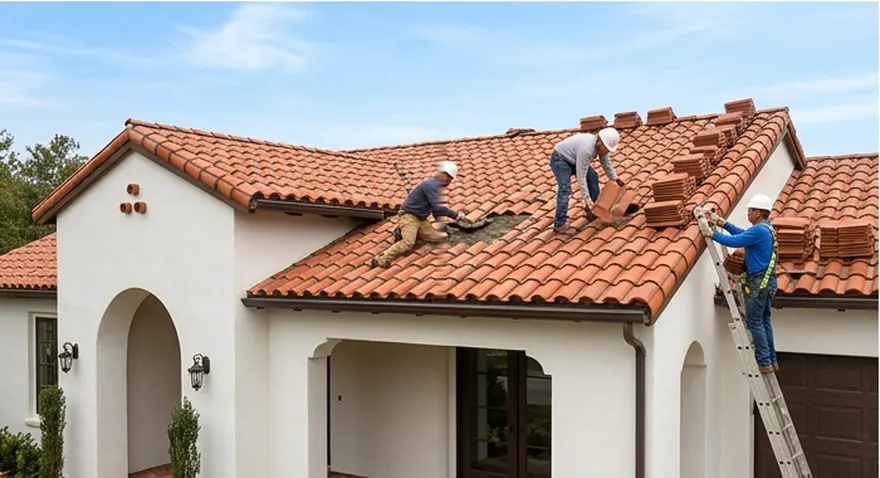
Tile roofs are common across Los Angeles County. The tile sheds most water, and the underlayment below does the rest. The open ends at the first course are a weak spot for embers and birds. Our guide to Class A roofs and wildfire covers the fire zone rules in Los Angeles County.
Weak Points by Threat
So the weakest part of a roof depends on what is hitting it. Use the table to match a problem to the part.
| Threat | Weakest part | What you can spot from the ground | Usual fix |
|---|---|---|---|
| Rain | Wall, chimney and valley flashing | Streaks or peeling paint on a wall below a roof joint | Reflash the joint, add a kick out |
| Rain | Pipe boots and vent collars | Cracked or split rubber around a pipe | Replace the boot |
| Wind | Corners, eaves and rakes | Lifted or missing pieces along the outer edge | Edge metal, starter strip, more nails at the edge |
| Wind | Roof to wall ties | Nothing. It is inside the attic | Straps or hurricane ties |
| Embers | Vents, gutters, open tile ends | Leaves in gutters, torn vent screens, gaps at the first tile course | Clean gutters, fine metal mesh, bird stops |
| Age | The open field of shingles | Bare spots, granules in the gutter, curled tabs | Repair or replace once it is worn |
Check Your Own Roof in Six Steps
You can do most of this from the ground with binoculars. Stay off the roof.
- Walk around the house. Look at every spot where a wall meets a roof.
- Find the bottom end of each roof to wall joint. Look for a kick out that sends water into the gutter.
- Count the pipes on the roof. Look for cracked or gray rubber at the base of each one.
- Scan the corners and the eaves for lifted or missing pieces after a windy night.
- Look in the gutters. Leaves are a fire risk. Piles of granules mean the field is wearing.
- Go into the attic on a rainy day with a flashlight. Look for wet wood near pipes, walls and the chimney.
If you find a problem at an edge or a joint, ask for a repair quote first. A good roofer will tell you when a flashing job is all you need. We built Roofs By Me so you can compare licensed roofers in your city before you call. Start in our roofing directory.
Where to Verify
Step and Kick Out Flashing at Roof Wall Intersections, Building America Solution Center, U.S. Department of Energy
Kickout Flashing, InterNACHI
Roof Leak. Ten Most Common Leak Locations, Tim Carter, Ask the Builder
Protecting Roofing Systems Against Windstorm Damage, FM Global
FORTIFIED Roof, Insurance Institute for Business and Home Safety
Evaluation of Nailed Roof to Wall Connections for Resistance to Uplift, Home Innovation Research Labs
Experimental Assessment of Wind Loads on Roof to Wall Connections for Residential Buildings, Feng and others, Frontiers in Built Environment, 2020
House Maintenance, Sustainable Defensible Space
What Buyers Want to Know
What is the weakest part of a roof?
The places where the roof stops or meets something else. Flashing at walls, chimneys, valleys and pipes is the weak point for leaks. The corners and outer edges are the weak point for wind.
What is the weakest roof to wall connection?
On many older homes it is the toe nail, a nail driven at a slant from the rafter into the top of the wall. Studies have found it vulnerable to wind uplift. Metal straps or hurricane ties are stronger.
Where do most roof leaks come from?
From joints, not the open field. The usual spots are pipe boots, roof to wall flashing, chimneys, valleys and skylights.
How long does a pipe boot last?
The rubber seal on a plumbing vent boot can fail in as little as 10 to 15 years, per Ask the Builder.
What part of a roof fails first in high wind?
The corners and the outer edges. FM Global says corner uplift can be more than 2.5 times the uplift on the middle of the roof.
Can bad flashing be fixed without a new roof?
Often, yes. A roofer can lift the shingles at the joint, replace the flashing and relay them. A worn out roof is the exception.